Medicare & Medicaid Guide for New York Seniors: Eligibility, Benefits, and Costs — All in One Place

Many people find them confusing because Medicare and Medicaid have very different rules, eligibility requirements, and benefit structures. This guide breaks down the key differences to help you make informed decisions.
📋 Table of Contents
Medicare vs. Medicaid: What’s the Difference?
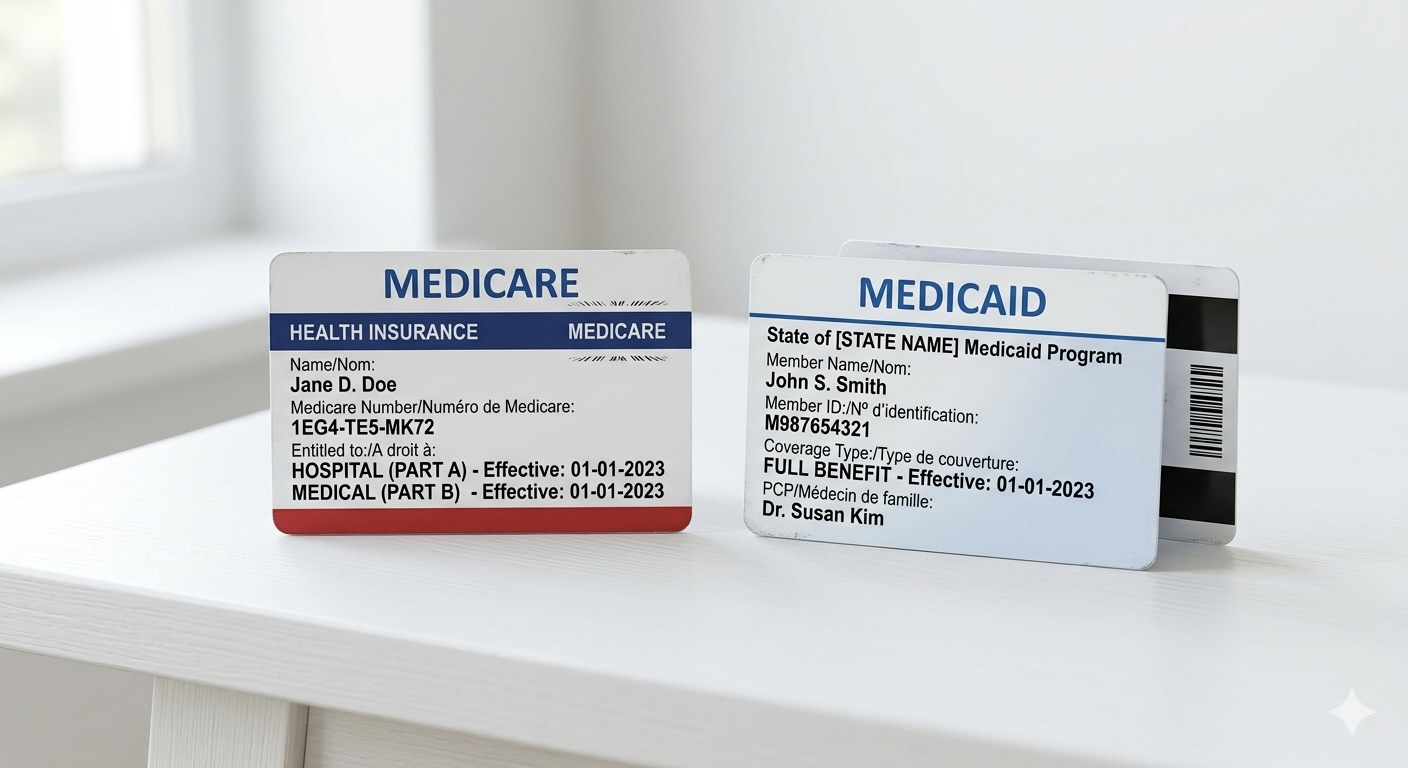
Despite their similar names, Medicare and Medicaid are two completely separate programs — different in how they’re funded, who they serve, and what they cover. Understanding the distinction is the first step to making the most of your benefits.
What Is Medicare?
Medicare is a federal health insurance program primarily for Americans aged 65 and older, as well as certain younger individuals with disabilities or specific medical conditions. Eligibility is based on age and work history — not income or assets.
- Federal program: Uniform standards apply nationwide
- Age-based eligibility: Primarily for adults 65 and older
- Premium structure: Part A is often premium-free with sufficient work history; Parts B, C, and D carry monthly premiums
- No asset test: Enrollment is based on age and work record, not your financial situation
What Is Medicaid?
Medicaid is a joint federal and state program that provides health coverage for individuals and families with limited income and assets. New York’s Medicaid program is among the most comprehensive in the country, but you must meet both income and asset requirements to qualify.
- State-administered: Eligibility rules and covered benefits vary by state
- Income & asset tested: Available to those who meet financial thresholds
- Low or no cost: Most covered services are free or very low-cost for enrollees
- Asset review required: Cash, savings accounts, and certain property are evaluated at enrollment
Medicare: Eligibility and Coverage Parts
Medicare is divided into four parts, each covering a different category of medical services. Most people enroll in a combination of parts based on their healthcare needs.
Basic Eligibility Requirements
- U.S. citizen or lawful permanent resident (green card holder for at least 5 continuous years), age 65 or older
- You or your spouse paid Medicare payroll taxes for at least 10 years (40 quarters) — required for premium-free Part A
- Under age 65 with a qualifying disability after receiving Social Security Disability Insurance (SSDI) for 24 months
- Any age with End-Stage Renal Disease (ESRD) or ALS (Amyotrophic Lateral Sclerosis / Lou Gehrig’s disease)
The Four Parts of Medicare (2026)
| Part | What It Covers | 2026 Monthly Premium |
|---|---|---|
| Part A | Inpatient hospital stays, skilled nursing facility care, hospice, home health services | $0 for most people (with 40+ work quarters) |
| Part B | Doctor visits, outpatient care, preventive screenings, durable medical equipment | ~$185.00/month (standard rate) |
| Part C | Medicare Advantage — combines Part A + B, often includes dental, vision, and hearing | Varies by plan (some $0 premium plans available) |
| Part D | Prescription drug coverage | ~$35–$100/month depending on plan |
For the latest Medicare information, visit the official Medicare website.
Medicaid: Eligibility, Income & Asset Limits
New York Medicaid offers some of the broadest coverage in the U.S., but applicants must meet both income and asset requirements. The thresholds below apply to seniors and adults with disabilities (non-MAGI Medicaid) in 2026.
2026 New York Medicaid Income Limits
| Household Size | Monthly Income Limit | Annual Income Limit |
|---|---|---|
| 1 person | ~$1,800/month | ~$21,600/year |
| 2 people | ~$2,430/month | ~$29,200/year |
| 3 people | ~$3,060/month | ~$36,700/year |
※ Income limits are adjusted annually based on the Federal Poverty Level (FPL). Actual eligibility depends on your individual circumstances at the time of application.
Asset Limits
In addition to income, Medicaid reviews your countable assets. The following limits apply to New York seniors under non-MAGI Medicaid in 2026:
- Individual: Up to approximately $32,396
- Married couple: Up to approximately $43,781
- Assets that do NOT count: Your primary residence, one vehicle, prepaid funeral expenses, and life insurance with a cash surrender value of $1,500 or less
※ Asset limits vary depending on the specific Medicaid program type and are subject to change.
Special Eligibility Categories
Different or expanded rules may apply to the following groups:
- Pregnant women
- Children and teenagers under age 19
- Individuals with disabilities
- Nursing home residents
- Individuals who are blind
How to Apply & Required Documents

Medicare and Medicaid are handled by different agencies with separate application processes. Be sure to apply to the correct program.
How to Apply for Medicare
Your initial enrollment window opens 3 months before your 65th birthday and closes 3 months after — a 7-month window total. If you’re already receiving Social Security benefits, you’ll be automatically enrolled in Parts A and B.
- Online: ssa.gov
- By phone: 1-800-772-1213 (interpreter services available)
- In person: Your local Social Security Administration office
Documents Needed for Medicare
- Social Security Number (SSN)
- Birth certificate, or proof of U.S. citizenship or lawful permanent residency
- Marriage certificate (if applying based on a spouse’s work record)
- Recent tax return or W-2 form (if applicable)
How to Apply for Medicaid in New York
New York Medicaid accepts applications year-round — there is no open enrollment period.
- Online: NY State of Health (nystateofhealth.ny.gov)
- By mail: Your local Medicaid office
- In person: Local Department of Social Services (DSS)
- By phone: 1-855-355-5777 (interpreter services available)
Documents Needed for Medicaid
- Government-issued photo ID (driver’s license or passport)
- Social Security card or proof of SSN
- Proof of income (pay stubs, Social Security award letter, pension statements, etc.)
- Proof of assets (bank statements, investment account statements, property records)
- Proof of New York State residency (utility bill, lease agreement, etc.)
- Proof of U.S. citizenship or immigration status
Benefits Comparison

Medicare and Medicaid cover different types of services. In some cases, you can qualify for both programs simultaneously — a status known as being “Dual Eligible.”
| Service | Medicare | Medicaid |
|---|---|---|
| Inpatient hospital care | ✓ | ✓ |
| Outpatient / doctor visits | ✓ | ✓ |
| Prescription drugs | Part D only | ✓ |
| Long-term care | Limited | ✓ |
| Dental care | ✗ | ✓ |
| Vision care | Limited | ✓ |
| Hearing services | Limited | ✓ |
| Non-emergency transportation | ✗ | ✓ |
Dual Eligible: Getting Both Medicare and Medicaid
If you qualify for both programs, Medicare acts as your primary insurance and Medicaid steps in as secondary coverage — filling gaps and dramatically reducing your out-of-pocket costs.
- Medicaid can pay your Medicare Part B monthly premium (~$185/month in 2026)
- Copays and deductibles may be waived or significantly reduced
- Prescription drug costs can drop to near zero
- Services not covered by Medicare — such as dental, vision, and hearing — may be covered by Medicaid
New York State Special Programs
Beyond Medicare and Medicaid, New York State offers several additional assistance programs for seniors. These programs help reduce costs for prescriptions, utilities, food, and in-home care.
1) EPIC — Elderly Pharmaceutical Insurance Coverage
A New York State program that helps seniors pay for prescription drugs. EPIC works alongside Medicare Part D to further reduce your out-of-pocket drug costs. To qualify in 2026, you must be 65 or older, a New York resident, and not enrolled in Medicaid.
2) Medicare Savings Programs (MSP)
These state-funded programs help pay your Medicare Part B premium and other cost-sharing expenses. There are four MSP levels (QMB, SLMB, QI, QDWI), each with different income thresholds. If you qualify, you could save over $2,000 per year on Medicare alone.
3) HEAP — Home Energy Assistance Program
Provides financial help with heating and utility bills during winter months. Applications typically open in November each year. This program is especially valuable for seniors on fixed incomes who face high energy costs in New York winters.
4) SNAP — Supplemental Nutrition Assistance Program
Commonly known as food stamps, SNAP helps low-income individuals afford groceries. Many Medicaid recipients also qualify for SNAP. In New York, seniors may be eligible for simplified SNAP enrollment.
5) HCBS Waiver — Home and Community Based Services
This Medicaid waiver program allows eligible seniors to receive long-term care services at home or in the community rather than in a nursing facility. Services can include personal care, adult day programs, and caregiver support — helping you stay independent for longer.
💡 By combining Medicare, Medicaid, and New York’s supplemental programs, eligible seniors can significantly reduce both healthcare and everyday living expenses.
📌 Quick Summary
- Medicare: Federal program for adults 65+ and certain people with disabilities — eligibility based on age and work history, not income
- Medicaid: Joint federal/state program for low-income individuals — income and asset limits apply; New York’s program is among the most generous in the U.S.
- Dual Eligible: Qualifying for both programs means more comprehensive coverage and dramatically lower costs
- NY Special Programs: EPIC, Medicare Savings Programs, HEAP, SNAP, and HCBS Waiver offer valuable additional support beyond standard coverage
* This article is for informational purposes only. Eligibility and benefits vary by individual circumstances — please consult a qualified benefits counselor or elder law attorney for personalized advice.