

💰 Medicare Savings Program 2026
If you have Medicare and a limited income, you could be leaving thousands of dollars on the table every year — and not even know it.
The Medicare Savings Program (MSP) is a New York State program that helps low- and moderate-income seniors pay for Medicare costs — including monthly premiums, deductibles, and copayments. Depending on which program you qualify for, MSP can save you over $8,000 a year.
And here’s the part most people miss: New York has no asset limit for MSP. That means your savings, home, and car generally do not count against you when applying.
This guide covers the two MSP programs available in New York in 2026 — QMB and QI — including income limits, what each covers, and exactly how to apply in NYC.
📚 Table of Contents
What Is the Medicare Savings Program?
The Medicare Savings Program (MSP) is a Medicaid-administered program that helps people with limited income pay for their Medicare costs. It is funded jointly by the federal government and New York State.
MSP is not the same as Medicaid. You can qualify for MSP even if your income or assets are too high for full Medicaid coverage. The two programs have separate eligibility rules.
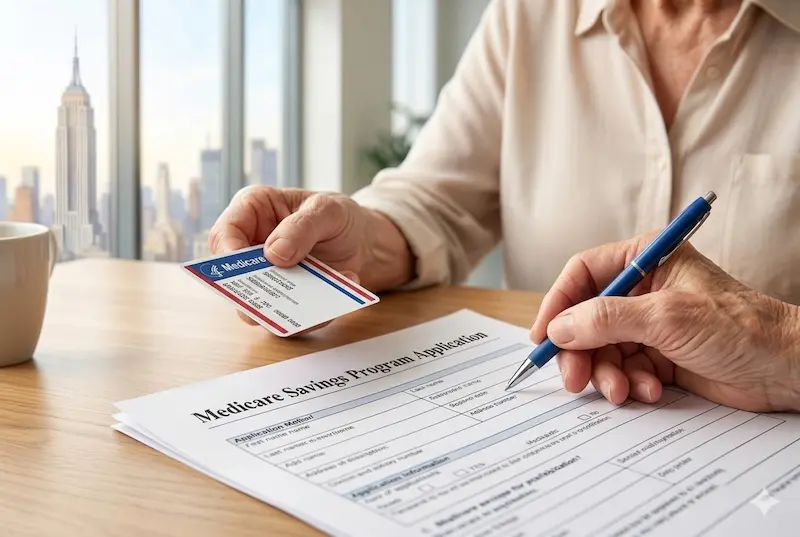
New York’s MSP in 2026: QMB and QI
Most states offer four MSP tiers. New York is different. Since 2023, New York eliminated the SLMB (Specified Low-Income Medicare Beneficiary) program by expanding QMB income limits to absorb those enrollees. That means in 2026, New York offers two MSP levels:
Qualified Medicare Beneficiary — the most comprehensive level. Covers Part A and Part B premiums, deductibles, and copayments.
Qualifying Individual — for those with slightly higher income. Covers the Medicare Part B premium only.
QMB: The Most Comprehensive Coverage
QMB is the strongest level of Medicare Savings Program assistance. If you qualify, it can cover nearly all of your out-of-pocket Medicare costs.
What QMB Covers
Medicare Part B premium ($185.00/month in 2026) — no longer deducted from your Social Security check
Medicare Part A premium if you don’t have enough work history to get it free
Part A and Part B deductibles — significantly reduces hospital and outpatient costs
Part A and Part B coinsurance and copayments — providers cannot bill QMB enrollees for these costs
QMB 2026 Income Limits (New York)
Monthly income at or below $1,820
Monthly income at or below $2,453
QI: Part B Premium Help
The Qualifying Individual (QI) program is designed for seniors whose income is slightly above the QMB limit. It covers one major expense: your Medicare Part B monthly premium.
At $185.00 per month in 2026, the Part B premium adds up to $2,220 a year. QI eliminates that cost entirely for eligible enrollees.
QI 2026 Income Limits (New York)
Monthly income at or below $2,446
Monthly income at or below $3,299
2026 Income Limits at a Glance
Here’s a quick side-by-side comparison of both programs for New York in 2026:
| Program | Single (Monthly) | Couple (Monthly) | What It Covers |
|---|---|---|---|
| QMB | Up to $1,820 | Up to $2,453 | Premiums, deductibles, copays (Part A & B) |
| QI | Up to $2,446 | Up to $3,299 | Part B premium only |
No Asset Limit in New York
This is one of the biggest advantages New York offers. Many states cap MSP eligibility based on savings and other assets. New York does not.
As of January 2026, New York has no resource limit for either QMB or QI. That means your bank accounts, retirement savings, home, and car are generally not counted when determining eligibility.
Bonus Benefit: Automatic Extra Help
When you enroll in any MSP — QMB or QI — you automatically qualify for Extra Help (also called the Low Income Subsidy, or LIS). This is a separate federal program that helps cover Medicare Part D prescription drug costs.
Extra Help is estimated to be worth up to $5,700 per year in prescription drug savings
In 2026, drug copays are capped at $5.10 for generics and $12.65 for brand-name drugs
If you were not enrolled in Part D, Extra Help removes the late enrollment penalty
Combined with the MSP premium savings, qualifying seniors can realistically save $8,000 or more per year in total Medicare costs.
How to Apply in NYC
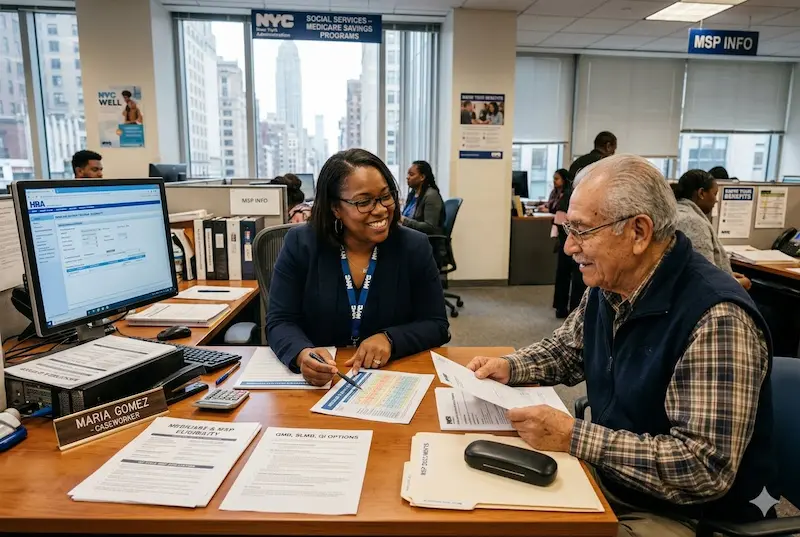
There are several ways to apply for MSP in New York City. Choose the option that works best for you:
Apply online or find your local office through the NY State Department of Health: How to Apply for NY Medicaid. Seniors 65+ apply through their Local Department of Social Services.
Print and mail a paper application (Form DOH-4328 PDF) from the NY State Department of Health website and send it to your local Department of Social Services.
Get free one-on-one help from DFTA’s HIICAP counselors. Call Aging Connect at 212-244-6469 or visit nyc.gov/aging to set up an appointment. Counselors speak multiple languages.
Call the Medicare Rights Center at 1-800-333-4114 for free application assistance and eligibility guidance.
What You’ll Need to Apply
Proof of identity (ID or passport), Medicare card, proof of income (Social Security award letter, pension statements), and proof of NYC residency
Where to Get Help

212-244-6469 — DFTA’s HIICAP program offers free Medicare counseling and MSP application help. Mon–Fri, 8:30am–5:30pm.
1-800-333-4114 — Free helpline for Medicare-related questions including MSP eligibility and enrollment.
1-855-355-5777 — State enrollment hotline. Also available at nystateofhealth.ny.gov to apply online.
1-800-541-2831 — For questions about the application process at your local Department of Social Services.
Dial 311 anytime to be connected to NYC senior services and get help finding the right program.
📝 Quick Summary
- MSP helps NYC seniors on Medicare save $8,000+ per year on premiums, deductibles, and drug costs
- New York offers two tiers: QMB (most coverage) and QI (Part B premium only)
- New York has no asset limit — your home and savings generally don’t count
- QMB income limit: $1,820/mo (single) · QI income limit: $2,446/mo (single)
- All MSP enrollees automatically get Extra Help for Part D drug costs
- Apply online at nystateofhealth.ny.gov or call 212-244-6469 for free help
This post is for informational purposes only and reflects 2026 program guidelines. Income limits and program rules are subject to change. Always verify current eligibility requirements with the NY State Department of Health or a qualified benefits counselor before applying.
📚 More from Riley